


According to Jing Muchun, chief engineer for the carrier rocket system of China’s manned space program, China is developing a new generation of high thrust carrier rockets to support the construction a space station. ”The building of a space station requires carrier rockets with greater thrust,” said Muchun, “ as each capsule of the station will weigh about 20 tonnes.” The Tiangong-1, [...]
Archive for September, 2011
Chinese Chief Designer Discusses Tiangong-1 Docking
According to Xinhua, China plans to use more speed and cut costs in order to acquire the technology, a crucial element in a space station program. ”We can never count on other countries to sell their mature technology to us, ” said Zhou Jianping, chief designer of China’s manned space program, “so we have to rely on our own.” This docking technology is [...]
Proton-M Launches QuetzSat-1
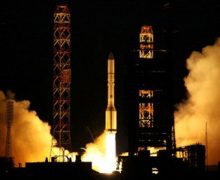
International Launch Services (ILS) has launched their Proton-M rocket on September 29, 2011, carying SES QuetzSat-1 telecommunications satellite. The launch, performed from the Baikonur Cosmodrome in Kazakhstan, was on schedule at 18:32 GMT; the satellite deploy happened nine hours into the flight. This is the second successful launch of a Proton since Russia resumed Proton flights following the failure of August 17, 2011, when a failure [...]
Video: NASA Mission Tracks Asteroids in NEO
Source NASA: NASA’s WISE mission has tracked down 93 percent of the 1 kilometer diameter or larger asteroids whose size could devastate our planet. The project’s asteroid census has revised the total number of NEO’s down from 36,000 to 20,500 (Credit: NASA/JPL). Andrea GiniAndrea Gini is a scientific journalist and a professional of the space industry, working as a contractor on ISS Payload [...]
SpaceX’s Reusable Launch System
SpaceX presented an animation of a fully reusable Falcon 9 (codename Grasshopper) with Dragon capsule during an appearance at the National Press Club on September 29, 2011. The video shows reentry and vertical return of both stages, as well as the Dragon capsule. According to Elon Musk, SpaceX founder and CEO, reusing the Falcon 9 rocket could lead to a 100-fold decrease in launch costs. Reuse could in fact [...]
Aurora Seen from Orbit
Souce NASA: This gorgeous view of the aurora (above) was taken from the International Space Station as it crossed over the southern Indian Ocean on September 17, 2011. The sped-up movie spans the time period from 12:22 to 12:45 PM ET. While aurora are often seen near the poles, this aurora appeared at lower latitudes due to a geomagnetic storm [...]
Infographic: The Chinese Space Station Program
The Tiangong-1 module is China’s first effort to orbit a station in space. The 8.5-ton station has been launched on September 29, 2011, and will be visited first by the crewless Shenzhou-8 automatic ferry craft. Later, Shenzhou capsules carrying up to three passengers will dock with the station during its planned two-year lifespan in orbit. Source SPACE.com: All about our solar [...]
China Launches Experimental Space Station Tiangong-1
The Tiangong-1, the first experimental Chinese space station module, has been launched on September 29, 2011, at 09:15pm (1315 GMT) from the Gobi desert in China’s northwest. The 8.5 tons Tiangong-1, Chinese for ”Heavenly Palace”, lifted off ontop of a Long March 2F rocket, the same launcher used for the manned Shenzhou spacecraft. The spacecraft separated successfully from its carrier rocket ten minutes into the launch, entering into a 200 km [...]
Movie: Dream Chaser CCDev-2 Status Update
Andrea GiniAndrea Gini is a scientific journalist and a professional of the space industry, working as a contractor on ISS Payload Safety. He is the Editor-in-chief of the Space Safety Magazine. Andrea is also Chairman of the Information and Communication Committee of the International Association for Advancement in Space Safety (IAASS), publisher of the Space Safety Magazine, and he is [...]
NASA Pinpoints Area of UARS Reentry
Source NASA: NASA’s decommissioned Upper Atmosphere Research Satellite fell back to Earth at 12 a.m. EDT (0400 GMT), as Friday, Sept. 23, turned to Saturday, Sept. 24 on the United States east coast. The Joint Space Operations Center at Vandenberg Air Force Base in California has determined the satellite entered the atmosphere over the Pacific Ocean at 14.1 degrees south latitude and 189.8 [...]


