


Archive for January, 2012

Efforts to Revive South African SumbandilaSat Abandoned

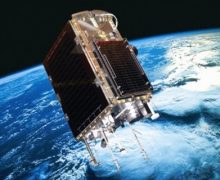
An artist's impression of SumbandilaSat in low-Earth orbit (Credits: defenceWeb).

SumbandilaSat, a South African Earth observation microsatellite, ceased to function due to damage it sustained during a solar storm in June 2010. During the storm, the power supply to the satellite’s onboard computer failed, and consequently, the satellite stopped transmitting images to the ground. The satellite’s developer, SunSpace, has abandoned efforts to revive the 100 million USD satellite, and has announced [...]

read more

Predicting Hazardous Events in the Van Allen Belts: Where Does the Radiation Go?

Artist concept of the twin Radiation Belt Storm Probes spacecraft, scheduled for launch in August 2012 (Credit: NASA).

Source: NASA When scientists discovered two great swaths of radiation encircling Earth in the 1950s, it spawned over-the-top fears about “killer electrons” and space radiation effects on Earthlings. The fears were soon quieted: the radiation doesn’t reach Earth, though it can affect satellites and humans moving through the belts. Nevertheless, many mysteries about the belts – now known as the [...]

read more

Progress M-14M Rocket Photographed From the Ground

Progress M-14M Rocket Photographed From the Ground

UPDATE: Some clear color views of the Soyuz-U rocket 3rd stage, which orbited the Progress M-14M.  The rocket will have reentered and decayed in meantime. Analyses of the obtained imagery suggest a relatively steady behave of this rocket compared to much more turbulent tumbling observed with other Soyuz launches. This was fairly well confirmed by the reasonable steady visual appearance [...]

read more

The Enduring Saga of Phobos Grunt

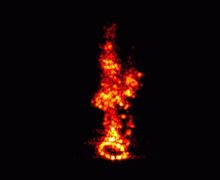
Radar image of the Phobos-Grunt probe in Earth orbit (Credits: Fraunhofer FHR).

Almost three months since the launch of Phobos-Grunt and fifteen days since the ill-fated spacecraft returned to Earth after being stranded in orbit, the chronicle of the mission endures and has yet to come to a conclusion.  During the telling of the tale, speculation about the spacecraft has run unbridled with conjecture relating to the technical aspects concerning the failure [...]

read more

ISS Dodges Chinese ASAT Debris

The International Space Station (Credits: NASA).

At 6:50 EST on January 28th, the ISS performed an avoidance maneuver to prevent a collision with a piece of space debris created by the 2007 Chinese anti-satellite (ASAT) test. The thrusters on the Zvezda module were fired for 1 minute and four seconds, raising the ISS altitude to just above 404 kilometers at its highest point. According to a [...]

read more

Soyuz Breach May Delay ISS Launch

A Soyuz launch in December carried three crew members to ISS (Credits: NASA).

A report on www.russianspaceweb.com indicates that Roscosmos found a breach in the supposedly air-tight walls of the Soyuz TMA-04M module slated to carry ISS Expedition 31/32 crew to the station on March 30. The launch may be delayed as a result. According to Ria Novosti, the problem was discovered on January 22 during a vacuum chamber test. It was relayed to [...]

read more

Lego “Astronaut” Reaches For Space

A photograph of the lego man at peak altitude (Credits: Mathew Ho and Asad Muhammad).

In another DIY success story, two Toronto high schoolers have succeeded in launching a would be lego “astronaut” into the stratosphere on a weather balloon. The flight, which reached a height of 24km before the balloon burst, was recorded in the video below. Some are calling it the most visible Canadian space presence since Canadarm.  Mathew Ho and Asad Muhammad, both [...]

read more

Strongest Solar Storm of 2012 in Decline

Image from the Solar Dynamic Observatory of January 27's CME (Credits: NASA).

On January 27, the sun released an X class coronal mass ejection (CME) from sunspot 1402, the same sunspot responsible for January 21′s M class CME. Although the latest flare caused an intial radio blackout on January 27, radiation levels have now declined to S2 (moderate) levels and no further interference is expected, according to NOAA’s Space Weather Prediction Center. “It’s [...]

read more

Aerospace Safety Advisory Panel Report Released

Aerospace Safety Advisory Panel Report Released

NASA’s Aerospace Safety Advisory Panel (ASAP) was established in 1968 in the aftermath of the Apollo 1 fire to evaluate NASA’s safety performance and advise the agency on improvement strategies. ASAP is required by the US Congress to submit an annual report to examine NASA’s safety culture as well as compliance with the Columbia Accident Investigation Board recommendations. ASAP’s 2011 [...]

read more

NEOShield Coalition to Investigate Asteroid Deflection Technologies

An artists conception of a Near Earth Object impacting Earth (Credits: Don Davis/NASA).

A new international consortium was launched this week to investigate the probability of an impact on Earth by one of the tens of thousands of Near Earth Objects (NEO) currently being tracked, and to investigate several potential options for collision prevention. The project, known as NEOShield, will be headed by the German Space Agency (DLR) in partnership with research institutions in [...]

read more