Articles written by: Hubert Foy

SLS External Tank Reverts to Hard Alloy

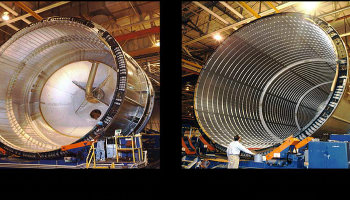
Comparison of SWT / LWT to SLWT LH2 Tank Barrels. Left: Standard Weight Tank (SWT) and Light Wight Tank (LWT) fabricated with Al 2219 alloy. Right: Super Light Weight Tank (SLWT) fabricated with Al 2219 alloy (Credits: NASA).

NASA is reverting to hard aluminum-copper alloy Al 2219 for use in the core stage of America’s next heavy-lift launch vehicle, the Space Launch System (SLS), reports NASASpaceflight.com. The change is a move away from more recent super lightweight aluminum-lithium alloy Al 2195 that the Agency used in manufacturing the lightest external tank design of the Space Shuttle, also known as the [...]

read more

Russian Meteor Explosion vs. Hiroshima Bomb: The Real Comparison

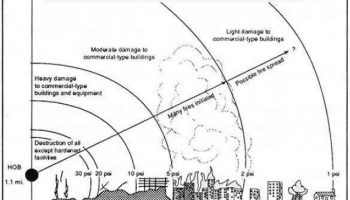
A simulated 500-KT atomic bomb dropped at 1,770 meter above a commercial city could generated powerful damaging shock waves of 30 psi at ground zero and decreases to 1 psi at radius of 14,162 meter.

On February 15 at 3:20:26 UTC, a supersonic flying space rock, roughly the size of a van or a small truck, entered Earth’s atmosphere, exploded at 24,140 meters over Russia’s Chelyabinsk, and produced a total destructive blast power of 500 kilotons. This means the destructive power yield was 30 times the blast yield of the U.S. atomic bomb, named Little [...]

read more

Eutelsat Adopts Anti-Jamming Tech In Upcoming Satellite

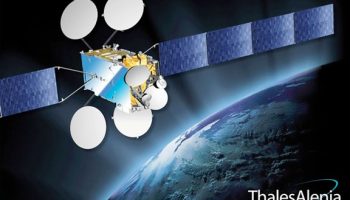
Artistic rendition of the EUTELSAT 8 West B satellite, courtesy of Thales Group

Paris-based commercial satellite fleet operator Eutelsat Communications recently announced plans to deploy an experimental cutting-edge TV channel interference mitigation function for the first time on its upcoming EUTELSAT 8 West B satellite. The satellite is scheduled for launch in 2015 and will be stationed over the Middle East and North Africa where Eutelsat has suffered deliberate jamming of its satellites [...]

read more

Reanalysis of 1883 Observations Suggests a Billion-Ton Comet Buzzed Earth

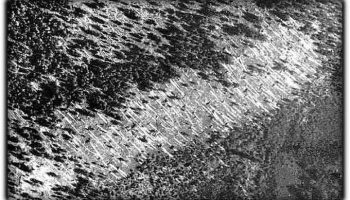
Tunguska region in 1938: Portion of one of the photos from Kulik's aerial photographic survey (1938) of the Tunguska region.
The parallel fallen trees indicate the direction of the blast wave.  About 2150 square kilometres of Siberian taiga were devastated and 80 millions trees were overthrown. Credit: University of Bologna.

On 12 August 1883 at 8:00 a.m., Mexico’s Zacatecas Observatory’s boss Jose A. Bonilla was preparing to study the Sun’s corona when he observed an amazing phenomenon. He saw several distant objects that were close together and crossing the solar disc. In the space of two hours, while the sky was clear and he was able to observe, he counted [...]

read more

NASA, ESA Try Out “Interplanetary Internet” Technology

International Space Station expedition lead Sunita Williams recently steered a Lego Mindstorms robot at an ESA facility in Darmstadt while she orbited overhead, proving that future space explorers could directly control a vehicle on a planetary surface while staying out of harm's way.

NASA and the European Space Agency (ESA) have successfully demonstrated an ”interplanetary” communication network that one day may enable internet-like communications between space mission controllers and deep space spacecraft or robotic rovers on another planet. U.S. astronaut Sunita Williams, commander of the International Space Station’s Expedition 33 mission, used NASA’s experimental Disruption Tolerant Networking (DTN) protocol to transmit two-way messages [...]

read more

ESA STE-QUEST Mission Could Help Unravel Origin of Flyby Anomaly

General concept of the STE-QUEST mission. The clock on the satellite is compared with one or more ground clocks as the satellite orbits earth on a highly elliptic orbit. During the perigee the local acceleration of two rubidium isotopes is measured and compared.

The European Space Agency’s (ESA) proposed Space-Time Explorer and Quantum Equivalence Principle Space Test (STE-QUEST) mission could help unravel the mystery of the flyby anomaly. Flyby anomaly occurs when a spacecraft taking advantage of the gravitational boost provided by an Earth flyby experiences a tiny extra boost in velocity. The anomaly was first observed in 1990 when NASA’s Galileo spacecraft velocity [...]

read more

Count Down to Nov. 1 Spacewalk to Repair Radiator Ammonia Leak

NASA astronaut Sunita Williams, Expedition 32 flight engineer, appears to touch the bright sun during the mission’s third session of extravehicular activity (EVA) on Sept. 5, 2012. Credits: NASA

In addition to their usual daily science and maintenance tasks, Expedition 33 Commander Sunita Williams of NASA and Flight Engineer Akihiko Hoshide of Japan living aboard the Earth’s orbiting laboratory International Space Station (ISS) are currently preparing hard for a Nov. 1 spacewalk. The spacewalk is needed to repair an ammonia leak on electrical power channel 2B, which is located [...]

read more

Effectiveness of Post Mission Disposal Rule Could Curtail LEO Debris Creation

Artist Conception of a satellite Breakup (Credits: William K. Hartmann).

Although predicting the future debris environment is very difficult, a new NASA study demonstrates the effectiveness of the 25-year Post Mission Disposal (PMD) rule currently in place in limiting the future debris population in low Earth orbit (LEO). “Controlling the growth of the orbital debris population is a high priority for NASA, the United States, and the major space-faring nations [...]

read more

Surviving Ebullism at 39 km: Baumgartner Jump Holds Promise for Space Suits

Austrian skydiver Felix Baumgartner survived his plunge, thanks in part to his specialized, pressurized protection.
Red Bull Stratos/Associated Press

In the early 1800s, laboratory experiments on normal healthy animals exposed to near vacuum environments revealed catastrophic consequences. A vacuum is characterized by the absence of life-sustaining characteristics present on Earth’s surface like oxygen, warmth, and pressure. Those experiments established that an altitude at and above roughly 19.2 km,  having a barometric pressure about one sixteenth of that at sea level, gas bubbles [...]

read more

Severe Weather Delays Baumgartner’s Launch to Tuesday

Leaping Into The Unknown BASE jumper Felix Baumgartner plummets toward Earth in a spacesuit during a test skydive. The grand attempt will be a jump from 120,000 feet. Jay Nemeth/Red Bull Content Pool.

The much awaited launch of the world’s most celebrated B.A.S.E. jumper Felix Baumgartner to an unprecedented altitude has been postponed from the morning  of Monday October 8 to, most likely, Tuesday morning. Baumgartner arrived at the Roswell Red Bull Stratos launch site in New Mexico on Friday to begin launch preparations when the professional meteorologist Don Day delivered the news of a 24-hour [...]

read more