
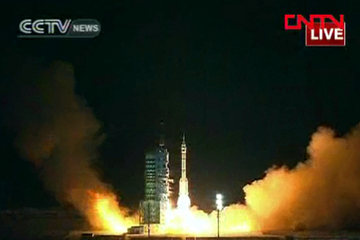
The launch of Shenzhou 8 (Source: CNN).
According to press agency Xinhua, China has successfully launched an unmanned Shenzhou spacecraft on Tuesday November 1. The spacecraft will attempt a rendezvous and docking with Tiangong – “Heavenly Palace” – the first Chinese experimental space station module launched on September 29. The spacecraft lifted off from the Gobi desert at 5:58 am (2158 GMT), then separated from its carrier rocket at an altitude of about 200 kilometers; the trip to the space station will take two days.
This is the first orbital docking experiment for China. A successful docking require mastery over several technologies, in order to allow two orbiting spacecraft to fly in formation and enter in contact without destroying each other. “As long as we are determined to rise in the world and pursue rejuvenation, we need to take risks,” said the Beijing based Global Times newspaper in an October 31 editorial, “Otherwise China will be a nation with prosperity but subordinated to top powers.”
The Chinese space program, which was started in 1990 with the acquisition of key technology from Russia, has allowed China to become the third country to send humans into space, after the former Soviet Union and the United States. Similar to the Soyuz, the Shenzhou spacecraft features a docking system compatible with the International Docking System Standard (IDSS), the same standard in use on the ISS. China is planning a larger, modular space station by 2020: if the Shenzhou 8 docking experiment will be successful, more will follow, including a manned mission in 2012.
In the video, below, the launch of Shenzhou 8.







![A trajectory analysis that used a computational fluid dynamics approach to determine the likely position and velocity histories of the foam (Credits: NASA Ref [1] p61).](http://www.spacesafetymagazine.com/wp-content/uploads/2014/05/fluid-dynamics-trajectory-analysis-50x50.jpg)


Leave a Reply