
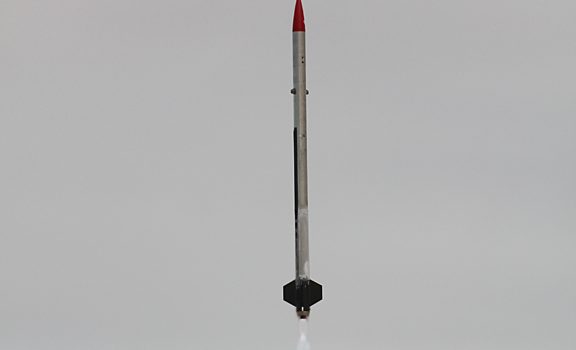
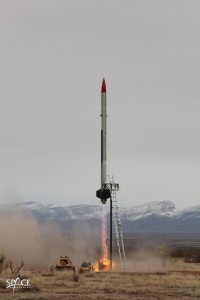
The STIG-A rocket launching from Spaceport America (Credits: Space Adventures).
On December 4th, Armadillo Aerospace conducted a successful launch of its reusable STIG-A suborbital rocket from Spaceport America, reaching an apogee altitude of 41.9 km. The purpose of the flight was to test an array of key technologies as part of the firm’s suborbital flight program.
Neil Milburn, Vice President of Program Management at Armadillo, said “This successful test of our “STIG A” reusable sub-orbital rocket technology represents major progress for the Armadillo Aerospace flight test program. […] The flight successfully demonstrated many of the technologies that we need for our manned sub-orbital program“.
The test flight is part the Armadillo suborbital vehicle development program, which aims to develop a reusable, vertical-takeoff vertical-landing (VTVL) suborbital rocket for the purpose of space tourism. It represents the thirteenth successful launch from dedicated commercial launch facility Spaceport America since 2006.
In addition to testing launch technologies, the rocket carried a scientific payload developed by students at the School of Aeronautics and Astronautics in the College of Engineering at Purdue University. The payload was an experiment designed to test behavior of a liquid and gas flow technology that is sensitive to the gravity environment present during launch.
Armadillo Aerospace, founded in 2000, is a leading developer of reusable rocket-powered vehicles. Along with its partner, Space Adventures, it aims to develop suborbital vehicles that could eventually be used to develop manned orbital vehicles.
The video below shows the launch of the STIG-A rocket from Spaceport America.
[youtube http://www.youtube.com/watch?v=Rz-wtnVUAEk]







![A trajectory analysis that used a computational fluid dynamics approach to determine the likely position and velocity histories of the foam (Credits: NASA Ref [1] p61).](http://www.spacesafetymagazine.com/wp-content/uploads/2014/05/fluid-dynamics-trajectory-analysis-50x50.jpg)


Leave a Reply