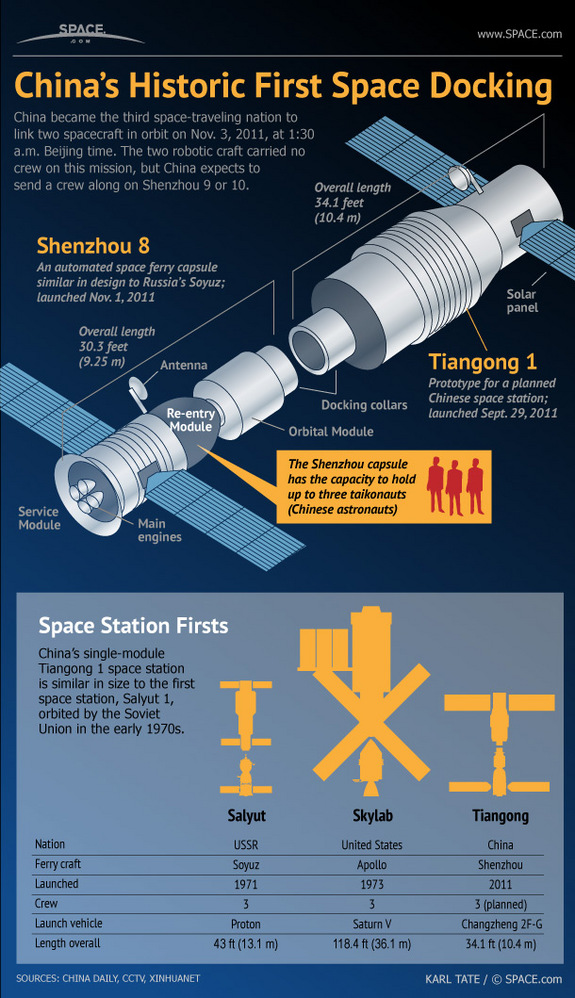
Infographic

Opportunity Rover Breaks Travel Record

A digitally simulated image of NASA's Opportunity rover in Endurance crater which it surveyed in 2005 (Credits: NASA/Z. Gorjian, K. Kuramura, M. Stetson, E. De Jong).

A well known constraint of robotic exploration is the speed at which robotic rovers travel. That is, they travel very slowly. A case in point is the Mars laboratory Curiosity. Since its landing in August 2012, Curiosity has travelled just 0.7 km. But one thing you can say for robots: they sure don’t give up. Until May 16, 2013, the [...]

read more

Chinese FAST Telescope to Surpass Arecibo

Arecibo radio telescope (Credits: NOAA)

When it comes to understand what’s going on in deep space, whether asteroids and Kuiper belt objects or pulsars and galaxies, it’s all about size. The bigger the telescope, the more it can detect. Since its completion in 1963, the Arecibo radio telescope in Puerto Rico has been the world’s largest single aperture telescope with a diameter of 305 m. [...]

read more

Russia’s Space Exploration Plan: Go Everywhere

Russia’s Space Exploration Plan: Go Everywhere

The Russian Academy of Sciences’ proposal for space exploration over the next decade can be succinctly summed up as: let’s go everywhere. Moon, Mars, Venus, Sun, Jupiter, and asteroids, they all make the list. Check out this graphic from RIA Novosti illustrating the grand plan: Staff WritersMore Posts

read more

Behind the Six Hour Trip to ISS

Behind the Six Hour Trip to ISS

On March 29, the first crew enjoyed a shortened trip aboard their Soyuz TMA-08M, totaling fewer than six hours down from two days. How was this flight different? Take a look: Source SPACE.com: All about our solar system, outer space and exploration Staff WritersMore Posts

read more

American Meteor Society Straightens Out the Space Rocks

American Meteor Society Straightens Out the Space Rocks

Ever get confused between a meteor and a meteoroid? Want to know exactly when an asteroid becomes a meteor? The American Meteor Society‘s Vincent Perlerin is here to help, with a handy infographic to keep it all straight. At the rate space rocks are falling these days, best get up to speed, and fast!   Infographic located by Moonandback.com Staff WritersMore [...]

read more

Comet ISON: What to Expect

ISON will look something like Hale Bopp on its 1997 pass as it approaches the Sun (Credits: Dennis di Cicco/CORBIS).

Skywatchers are getting excited about the passage of Comet ISON, even though it’s months away, at the end of November. Why all the fuss? ISON is coming in fresh from the Oort cloud, making its first inner solar system passage of the Sun. That means it should be loaded with volatiles that will vaporize during its passage, both creating spectacular [...]

read more

Orbital Delivery: Complete Guide to Unmanned Cargo Spacecraft

Orbital Delivery: Complete Guide to Unmanned Cargo Spacecraft

The International Space Station gets it supplies from an ever-growing array of unmanned cargo ships, including the Japanese HTV, the European ATV, the Russian Progress, and the commercial Dragon that just rendezvoused with ISS after a brief thruster scare. There are yet more on the way, with the next ship to launch being Orbital Sciences’ Cygnus demonstration mission, now that [...]

read more

Inspiration Mars: How it will Work

Inspiration Mars: How it will Work

The buzz started well before Inspiration Mars’ February 27 press conference, but it has only gotten louder in the hours since. With little more than a feasibility study to be formally published on March 3, Dennis Tito and his conclave of they-could-actually-pull-this-off specialists have committed to send an American man and woman on a flyby mission to Mars in 2018. [...]

read more

Previewing Asteroid 2012 DA14

Previewing Asteroid 2012 DA14

 Although it has been well established that Asteroid 2012 DA14 will not impact Earth on February 15, the historic closeness of the flyby, falling within the planet’s ring of geostationary satellites, has captured the public imagination. Have a look at the 49 m asteroid that will soon make its closest approach.    Source SPACE.com: All about our solar system, outer [...]

read more

Exploring Bigelow’s Station Module

The Bigelow Expandable Activity Module (BEAM) on the ISS as it should appear in 2016 (Credits: NASA).

After years of concept development and a couple unmanned test runs, Bigelow Aerospace is on the verge of actually puts its inflatable space habitats to work. First up will be the 4 meter long, 3.2 meter diameter, 1,360 kg Bigelow Expandable Activity Module (BEAM) slated to be launched aboard a Falcon 9 and robotically attached to Node 3 of the [...]

read more