
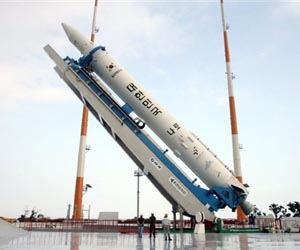
KSLV-1 being erected at the Naro Space Center launch pad (Credits: AFP).
On November 22, South Korea announced that it would launch Korea Space Launch Vehicle-1 (KSLV-1) on November 29. The launch was delayed from October 26 due to a fuel leak.
“Engineers from Russia and South Korea met on Monday and agreed it would be technically appropriate to carry out the launch on November 29,” said Kim Yeon-Hak, deputy director of the Science Ministry, which is responsible for the satellite. The Korea Aerospace Research Institute (KARI) is in charge of the launch vehicle.
The leak was traced to a broken rubber seal in a connector between the launch pad and the first rocket stage. A replacement adaptor bloc was supplied by Russia, who manufactured the first stage of the launcher based on the Angara rocket’s first stage. KARI built the second stage, a solid-fuel rocket.
This is South Korea’s third attempt to launch KSLV-1, also known as Naro-1. In a 2009 launch attempt, the second stage failed to release the satellite, preventing deployment. In the second launch in 2010, the launcher didn’t even reach orbit, exploding two minutes into its flight. Although no official cause of the failures was announced, unspecified changes have since been made to first stage, the second stage flight termination system was eliminated, and the payload fairing electrical system was refined for the third flight.
The collaboration between South Korea and Russia was mainly spurred by the United States, who for years tried to impede South Korea – and other countries – from developing indigenous launch capability out of fear it could be used to launch ballistic missiles. The venture has been somewhat bumpy, with delays seen in Russian components and both countries blaming each other for launch failures.
The launcher will carry the 100 kg Science and Technology Satellite 2C (STSAT-2C). The satellite will collect some radiation observations in space during its one year lifetime, but is mostly considered a technology demonstrator.
Below, the unsuccessful second launch of KSLV-1:






![A trajectory analysis that used a computational fluid dynamics approach to determine the likely position and velocity histories of the foam (Credits: NASA Ref [1] p61).](https://www.spacesafetymagazine.com/wp-content/uploads/2014/05/fluid-dynamics-trajectory-analysis-50x50.jpg)


Leave a Reply