
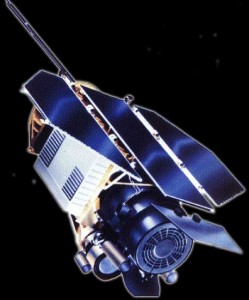
The german ROSAT space telescope (Credits: PD-USGov-NASA).
The reentry of NASA’s UARS satellite, expected by the end of today, September 23, is not an isolated event. A 2.4 tonnes German X-Ray telescope is expected in fact to plunge into Earth’s atmosphere at the end of October. The massive ROSAT, short for Röntgensatellit, was built by the German aerospace agency DLR, and launched by NASA on June 1, 1990 on a Delta II rocket. The satellite, designed for a 5 years mission, worked for 8 years, until February 12, 1999.
Mission requirements drove the design of a large shield to protect the spacecraft’s mirrors. Now, the shield is likely to increase the mass and size of the debris that will result from the impact of ROSAT with Earth’s atmosphere.
According to ROSAT website, DLR estimates that “up to 30 individual debris items with a total mass of up to 1.6 tonnes might reach the surface of the Earth. The X-ray optical system, with its mirrors and a mechanical support structure made of carbon-fibre reinforced composite – or at least a part of it – could be the heaviest single component to reach the ground.”

Fluctuations in solar activity affect ROSAT’s reentry (source: DLR).
Time and position of reentry cannot be neither predicted, nor controlled: ROSAT is currently deactivated, and cannot be driven to a controlled reentry into the ocean. Moreover, variation in solar activity and the geometry of the thumbing satellite will affect the decay of its orbit, until its natural reentry, expected by late October or early November.
As with UARS, the satellite is tracked by US Strategic Command, but ROSAT is not yet on the upcoming list because of the uncertainty of its reentry time.

Sample representation of ROSAT’s location (Source: DLR).







![A trajectory analysis that used a computational fluid dynamics approach to determine the likely position and velocity histories of the foam (Credits: NASA Ref [1] p61).](http://www.spacesafetymagazine.com/wp-content/uploads/2014/05/fluid-dynamics-trajectory-analysis-50x50.jpg)


Leave a Reply